
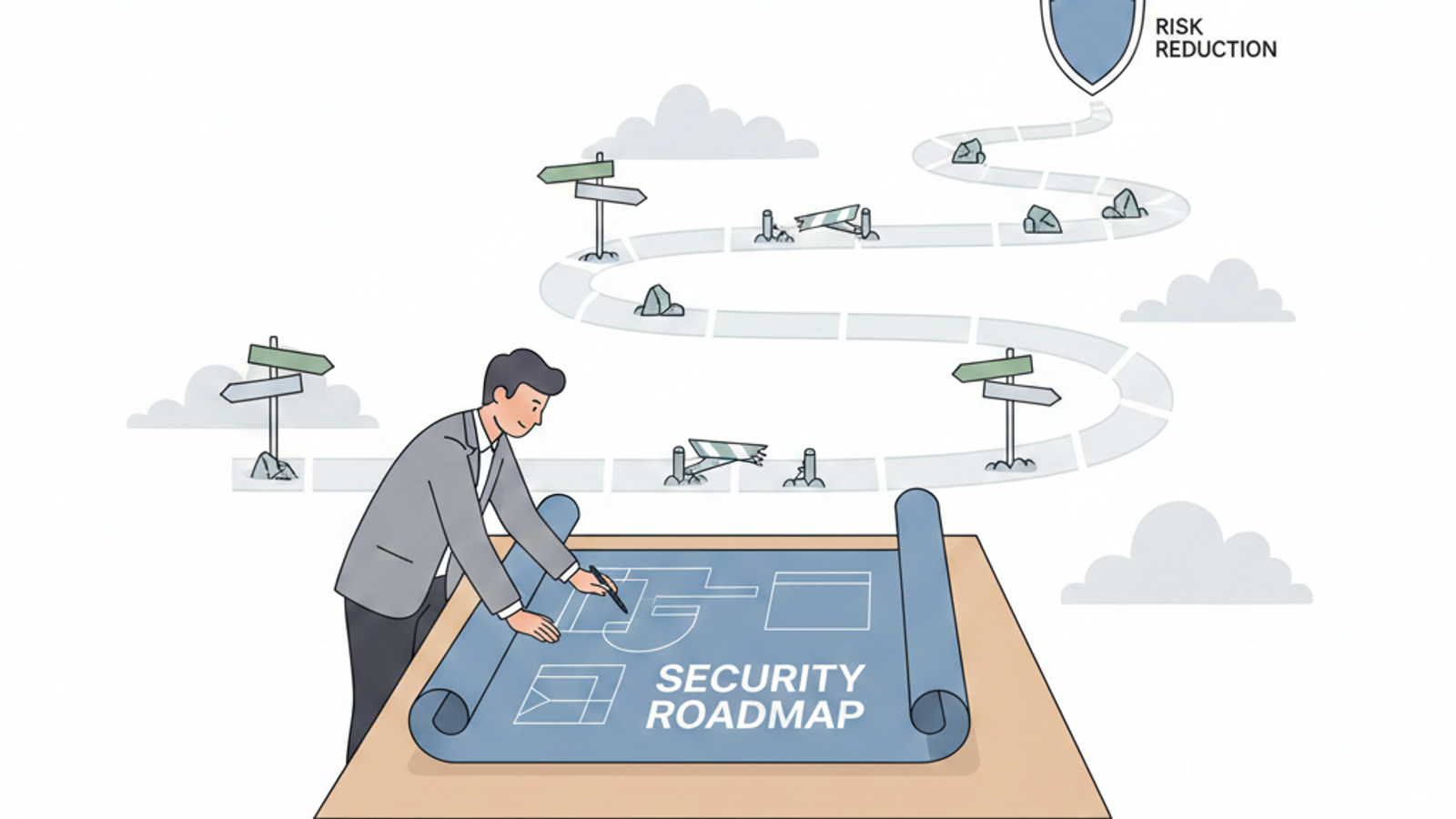
Most security plans stall at the doing.
When I talk to vCISOs (part time CISOs) and CISOs, I keep hearing the same story. The plan is clear, leadership agrees, and the risk calls make sense. Then months go by and the company’s actual security posture barely changes.
Meanwhile the pressure on founders gets more specific. A bigger customer wants proof. A security questionnaire turns into a follow up call. Cyber insurance asks for details, not good intentions. Or a real incident happens and suddenly everyone cares about the basics that have been sitting on a list for a year.
This is where the work gets uncomfortable. You can align everyone and prioritize perfectly, but risk still stays high if nobody has enough capacity to ship the security work. Security keeps competing with product deadlines and day to day operations, and it loses more often than people admit.
What’s happening when “security is a priority” but nothing changes
Most small teams do not have a dedicated lane for security work. They have a product lane and an operations lane, and security is expected to ride along with both.
That can work when the security tasks are small and rare. It breaks the moment security becomes a recurring expectation with deadlines and outside scrutiny.
The failure mode is rarely “we don’t care.” It’s drag. The work that actually reduces risk is usually unglamorous, spread across multiple systems, and easy to postpone because the downside is delayed. You can have the right priorities and still lose to the calendar.
What I see a lot is a team that is capable, but not set up to reliably ship security changes. They can ship features quickly, but they struggle to consistently ship things like stronger logins, laptop and server protections, email and domain protections, backup testing, and cloud configuration fixes. The result is a roadmap that sounds good, but doesn’t turn into measurable reduction in exposure.
A common trap: seeing gaps is not the same as reducing risk
Founders often assume the answer is buying a compliance platform or a set of security tools. They want a dashboard, a score, and the feeling that things are handled.
Those tools can help, but they are not the work. They show you what is missing. They do not fix it.
A report that says “MFA is not enforced everywhere” is not risk reduction. Risk reduction is enforcing MFA everywhere, testing it in the real login flows, cleaning up exceptions, and being able to prove coverage.
The same trap shows up with hiring. “We just need to hire a security engineer” can be the right move at a certain size, but it is not a universal fix for a small team. One person can become the bottleneck. Or they end up writing guidance while the actual changes still sit behind product and operations work.
This is why the strongest vCISO engagements I hear about are not only about the plan. They are about converting the plan into shipped changes that hold up in real life.
What “good” looks like when you want measurable risk reduction
Teams that make real progress treat security like delivery, not like advice.
The vCISO sets direction, makes tradeoffs explicit, and keeps leadership aligned on what matters right now. A delivery team turns that direction into a small backlog of work with a clear definition of done, tied directly to risk outcomes.
This is a focused delivery motion that gets a baseline shipped, verified, and hard to quietly slide backward.
In practice, strong delivery has a few consistent traits.
Work is defined as outcomes, not activities. “MFA coverage at 99 percent with time bound exceptions” is better than “roll out MFA.”
Each change has a clear done state. The setting is live, coverage is measured, edge cases are handled, and rollback or recovery steps are written down when they matter.
Validation is part of the work, not a future hope. You test the real flows, confirm the safeguard holds under normal use, and confirm you’ll notice if it slips later.
The output includes reusable proof, not just “trust us, we changed it.” That proof can be as simple as config exports, screenshots, short summaries of what changed, how it was tested, and receipts you can reuse for buyers, insurers, or audits.
This is where the vCISO stays the hero of the story. They already know what matters, what can wait, and how to frame risk in a way leadership will actually fund. Our job is to make that intent real, quickly, without dragging the team into weeks of overhead.
Proof that holds up is a byproduct of disciplined execution
Proof is not just “compliance paperwork.” It is how you make progress portable across time, staff changes, and buyer expectations.
A simple example is login enforcement slipping over time. A company rolls out stronger authentication for admins and thinks it’s done. Two months later someone creates a new admin account in a rush, it ends up in the wrong group, and it quietly bypasses the policy. Nothing breaks, so nobody notices. The risk returns without a headline.
If the team produces a small monthly proof pack, that type of slip gets caught because coverage is measured, exceptions are reviewed, and the safeguard is treated like a living system. The proof is the receipt that the safeguard still exists in practice, not just in someone’s memory.
I didn’t fully appreciate this until we started doing delivery work, but proof is often the easiest way to tell whether a security change is real. If you can produce clean proof on a cadence, you are usually doing the underlying work. If you cannot, your setup is changing faster than anyone admits.
The partnership model that keeps friction low
A good delivery partner does not replace a vCISO. It makes the vCISO more effective by shrinking the distance between decision and outcome.
The cleanest model is simple. The vCISO owns the roadmap, prioritization, and leadership alignment. Our team owns implementation, validation, and packaging proof so it is reusable. The interface stays tight, lightweight, and focused on outcomes.
This also means being intentional about what work you take on. For startups and small teams, the winning move is choosing changes you can ship end to end with minimal dependencies.
Stronger identity and access, device protections, email and domain protections, backups you actually test, and asset inventory are popular for a reason. They reduce multiple risks at once and they create proof that customers and insurers recognize.
The tradeoff is that some initiatives that sound strategic are slow, expensive, and dependency heavy. Deferring them is a sensible call for a small team moving fast.
The next expectation is ongoing proof, not one time readiness
Pressure is trending toward ongoing proof. Buyers are getting more specific. Insurers are tightening requirements. Fast vendor adoption and AI driven workflows are pushing sensitive data into more places, faster, often before anyone has time to add guardrails.
This does not mean every company needs heavyweight process. It means the baseline has to be durable and repeatable. The bar is moving from “we have a policy” to “we can show it works, and we can show it again next quarter.”
vCISOs who can pair strategy with predictable shipping stand out, because they make security feel boring in the best way. Progress becomes a cadence, not a fire drill.
Practical next step: make progress predictable in the next 30 days
-
Pick one risk theme that matters right now. Stronger logins, backup reliability, or device protections are good candidates. Define three measurable outcomes you want to see, including how you will measure them.
-
Convert that slice of the roadmap into five to eight pieces of work with a clear definition of done. Make testing and proof part of each item, not a separate phase.
-
Ship the first two changes end to end in a week. Use what you learn to tighten your definition of done and your proof template.
-
Publish a short monthly proof pack that includes coverage numbers, exception status, and simple artifacts for the safeguards you touched. Keep it consistent so it becomes reusable.
-
Review for backsliding monthly. If something slips, treat it like a product bug and fix the delivery system, not just the symptom.
If you want a delivery lane you can plug into your roadmap without adding overhead, reach out and we can compare notes on what’s stalling in your real setup. We’ll help you pick a small slice that can ship quickly, define a clear done state, and show what “reusable proof” looks like so progress stays defensible and predictable.